In Miami-Dade, a peeling epoxy floor is almost never a resin problem. It is a water problem. The ground beneath your slab is wetter, saltier, and more porous than almost anywhere a coating gets installed in the United States — and unless someone measures that before the resin goes down, the floor is on the clock from day one.
Picture a typical scenario in Kendall or Westchester: a homeowner pays for a glossy garage floor in the dry weeks of March, loves it through spring, then watches it cloud, bubble, and lift the first week of June when the rainy season opens. The coating did not wear out. It was pushed off from below by vapor rising out of the slab — the same vapor that was always there, just waiting for the wet season to turn up the pressure. This guide is about that hidden force: why Miami's geology and coastal climate make it more aggressive here than nearly anywhere else, the standardized tests that read it before a single gallon is mixed, and the exact questions that tell you whether the contractor in your driveway understands the ground he is about to coat.
Why Coatings Lift Off Miami Slabs
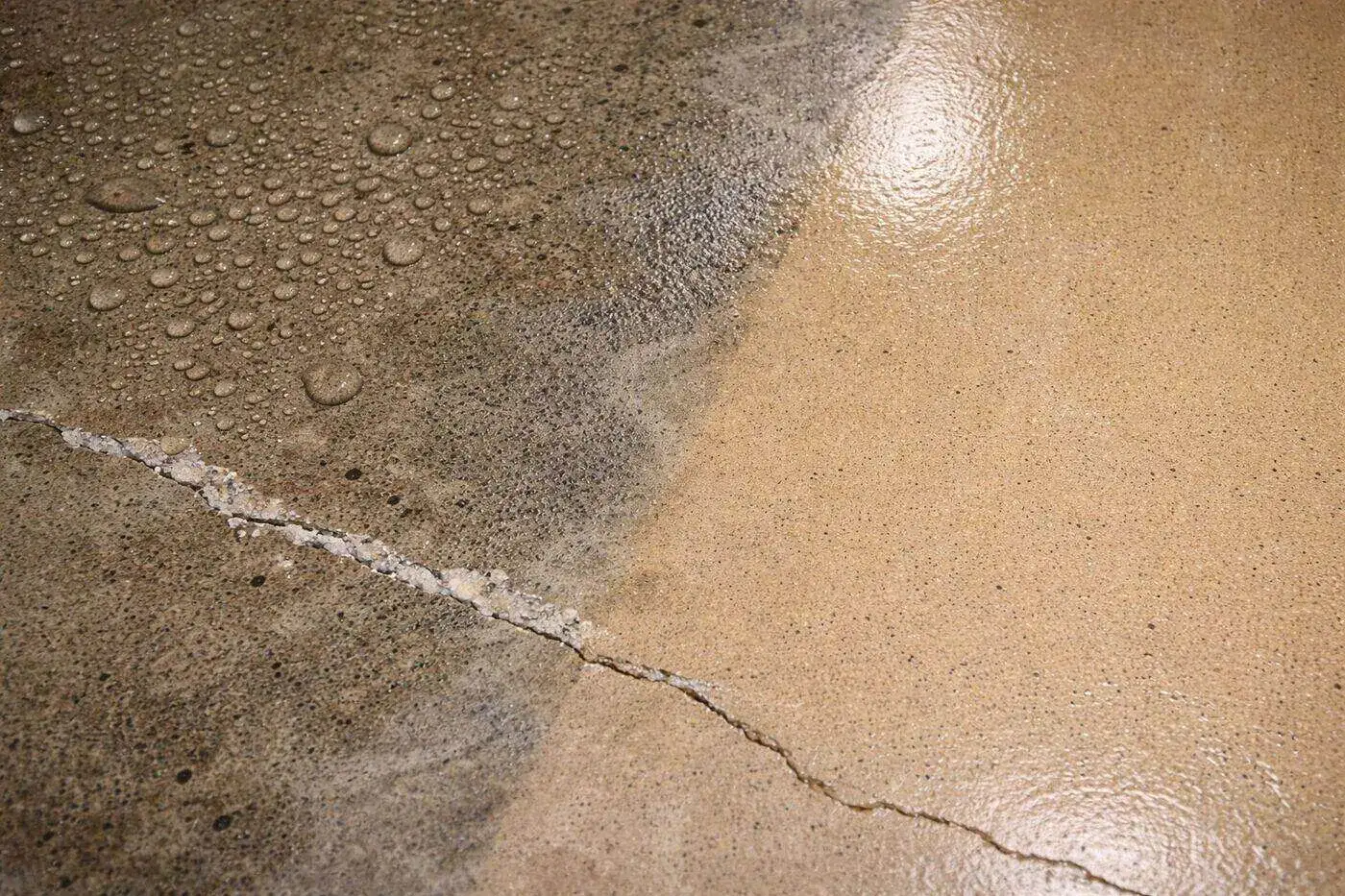
A cured epoxy floor is essentially a thin plastic skin chemically gripping the top millimeters of your concrete. That grip is strong — but it pulls in only one direction. When groundwater under the slab evaporates and migrates upward as vapor, it presses against the underside of that skin continuously, day and night. Concrete is porous enough to let the vapor through; the cured coating is not. So the moisture stacks up at the bond line, builds pressure, and over a few wet months simply peels the film away. You see it as blisters, milky-white haze, and eventually loose sheets you can lift by hand.
The technical name is moisture vapor transmission, and across the coatings industry it is the leading cause of premature epoxy failure — ahead of bad product, ahead of sloppy mixing, ahead of foot traffic. What makes it maddening is that none of it is bad luck. Vapor transmission is a measurable quantity. A meter reads it in an afternoon. An installer who takes that reading can engineer the floor around it; an installer who skips it is quietly betting your money that the slab is dry, in a county where that bet usually loses.
The Miami-Dade Ground Is Working Against You
Most of Miami-Dade is built on the Miami Limestone — a soft, porous oolitic bedrock that behaves more like a sponge than a barrier. Rain and groundwater move through it freely, and across much of the county the water table sits only a handful of feet below the surface, rising further during the wet season and king tides. That shallow, ever-replenished reservoir feeds a steady column of vapor straight up into the slabs sitting on top of it. A floor in flood-prone, low-lying areas like Sweetwater, Hialeah, or the bayfront blocks of Edgewater is fighting that column every single day.
Two more Miami-specific forces stack on top of the water table. First is salt: coastal and bayfront slabs from Brickell to Aventura pull in chloride-laden moisture, and salts crystallizing at the bond line will push a coating off as effectively as plain water. Second is the building stock itself. Miami-Dade's housing runs from mid-century slab-on-grade ranches in Westchester and Cutler Bay to high-end coastal homes and dense urban infill — and a huge share of the older slabs were poured with thin, degraded, or nonexistent vapor barriers underneath. High water table above the barrier's failure point, salt in the mix, and no defense in the slab: that is why mitigation is the norm on Miami-Dade jobs rather than the exception it would be in a dry, high-and-flat inland market.
This is not a worst-case story dressed up to sell a service. Coatings labs and installers across South Florida routinely log slab readings well over the safe threshold — concrete that looked bone-dry, took a perfect-looking coat, and would have failed by the next rainy season had it not been ground open and sealed with a vapor barrier first. The eye cannot see it. Only the meter can.
The 75% Relative Humidity Threshold
Concrete hides its moisture. A slab can feel dry under your palm and still be loaded with water deep inside, so the coatings industry does not judge by touch — it judges by internal relative humidity, the moisture level measured inside the slab itself. The working rule is simple: epoxy bonds reliably under roughly 75 percent internal RH. Cross that line and the odds of failure climb fast, regardless of how good the resin is.
Miami stacks the deck against that number from two directions at once. From below, the shallow water table keeps slabs damp year-round. From above, the air itself is rarely dry — Miami runs humid most of the year and takes on the order of 60 inches of rain annually, the bulk of it dumped during the May-to-October wet season and hurricane months. When a contractor lays resin into that soupy air, the coating can develop amine blush: a greasy, cloudy film that means the epoxy never cured right and will not hold. On a muggy August afternoon in Miami-Dade, the risk of blush is not a footnote — it is the default condition you have to actively work around.
So a contractor who actually knows this market does not coat by the calendar or by feel. He probes the slab for internal RH, checks the surface, watches the dew point, and times the pour for a window the concrete and the air can both survive. Put a coating on a slab reading north of 75 percent RH and you have not installed a floor — you have scheduled its failure.
Worried About Moisture in Your Slab?
We test before we quote. Get a straight answer about your concrete and a system built to hold in South Florida.
The Moisture Tests That Catch the Problem
None of this has to be a guessing game. The construction industry settled this question decades ago with standardized ASTM tests that put an actual number on how much moisture your slab is moving. In a market like Miami-Dade, running at least one of them is not optional diligence — it is the entry fee for doing the job honestly. Three are worth knowing, and they are not interchangeable.
The plastic sheet test (ASTM D4263) — the quick screen
Start with the simplest. The installer tapes a square of clear plastic tightly to the concrete and leaves it overnight or longer. If beads of condensation appear underneath, or the slab darkens beneath the sheet, moisture is on the move. It costs almost nothing and takes a day, which makes it a fine red-flag check — but it only tells you whether moisture exists, never how much. On a Miami slab it should be the opening move, not the final word.
The calcium chloride test (ASTM F1869) — pounds at the surface
This older quantitative method sets a small dish of calcium chloride salt on the sealed slab and weighs how much moisture it pulls out over a set period, reported as pounds per 1,000 square feet over 24 hours. The accepted ceiling for most coating systems is 3 pounds; above it, vapor pressure is high enough that delamination becomes a real risk and a barrier is called for. It is a legitimate reading, but it only measures what is leaving the top surface — which is why the trade has largely moved past it for the test below.
The RH probe test (ASTM F2170) — the one that matters most
This is the gold standard, and the test you actually want run on a Miami-Dade slab. The installer drills into the concrete, seats sealed probes, and reads the relative humidity deep inside the slab — the moisture that genuinely drives coating failure, not just what has reached the surface today. Because it reads where the failure starts, ASTM F2170 is the number most manufacturers tie their warranty conditions to. Under roughly 75 percent RH and you are clear to coat; over it, the slab gets mitigation before anything decorative goes down.
| Test | What It Measures | Safe Range |
|---|---|---|
| Plastic Sheet (ASTM D4263) | Visible moisture (screening only) | No condensation under sheet |
| Calcium Chloride (ASTM F1869) | Surface moisture emission | Under 3 lbs / 1,000 sq ft / 24 hrs |
| RH Probe (ASTM F2170) | Internal slab humidity (best read) | Below ~75% RH |
How a Vapor Barrier Fixes a Wet Slab
A slab that tests wet is not a slab you have to walk away from — it just changes the first step. The fix is a moisture-mitigation primer, sometimes called a vapor-barrier coating. The crew diamond-grinds the concrete to open its pores, then rolls down a specialized epoxy primer engineered to hold back vapor pressure that would destroy an ordinary coating. That primer becomes the dam: it caps the rising moisture and gives the decorative layers on top a stable, dry surface to grip. A slab that read 90 percent RH in the morning can take a full epoxy or polyaspartic system that afternoon once the barrier is down.
It does add cost — usually $1.50 to $3.00 per square foot over the base price, plus the moisture test itself at roughly $200 to $400 — and in Miami-Dade you should expect to see it on a real quote far more often than not. But framing it as an "extra" gets the logic backward. On a slab this wet, the mitigation primer is not what makes the floor pricier; it is what makes the floor exist at all. The alternative is not a cheaper floor — it is the same floor peeling off the concrete by the time the June rains arrive, and paying twice to redo it.
This is also the cleanest tell for sorting honest Miami quotes from dangerous ones. A contractor who tests before he prices can quote you the floor your slab actually needs. A contractor who quotes a flat number sight-unseen has either assumed your slab is dry — a bad assumption in this county — or quietly left mitigation out to look cheaper. When two bids are far apart in Miami-Dade, the low one is very often the one missing the line item that keeps the floor on the ground.
What to Ask Before You Hire a Contractor
You will not out-expert a flooring contractor on chemistry, and you do not need to. You need six questions and the discipline to notice whether the answers are concrete or evasive. Ask these of anyone standing in your Miami driveway with a clipboard, and the right installer will sort himself out of the pack in about two minutes.
- Do you test the slab for moisture before you give me a price? "Yes" is the only safe answer, and a real one names a method — an ASTM F2170 RH probe or an ASTM F1869 calcium chloride test. In Miami-Dade, anyone quoting a firm number without a reading is guessing on the most important variable.
- What number tells you a slab is too wet to coat? You want to hear the roughly 75 percent internal RH threshold, or the 3-pound calcium chloride limit. If those numbers are news to him, he has never been the one accountable when a floor failed.
- If mine reads high, then what? The answer you want is a diamond grind plus a moisture-mitigation or vapor-barrier primer — a specific plan, not "we'll seal it good" or "it'll be fine."
- How are you prepping the concrete? Diamond grinding is the only acceptable answer in this climate. An acid wash or a light scuff will not open a Miami slab enough for the coating to hold against vapor pressure.
- Is the topcoat UV-stable? South Florida sun yellows cheap coatings, and a Miami garage door open half the day lets it in. A polyaspartic or polyurea topcoat is built to take both the UV and the humidity; a bargain epoxy alone is not.
- What does the written warranty cover, and what voids it? A warranty in writing tells you he stands behind his prep. Read the exclusions — the fine print is where a contractor who cut the moisture step hides.
A contractor who answers these without flinching is telling you he understands the specific patch of Miami-Dade limestone he is about to coat — and that understanding, far more than the resin brand or the headline price, is what decides whether your floor still looks new after five wet seasons. For the dollars-and-cents side, our companion guide on how much epoxy flooring costs in Miami walks through each finish — from a roughly $4,000-and-up two-car garage to metallic and commercial systems — and exactly where moisture mitigation lands in the total.
Frequently Asked Questions
Why does the Miami-Dade ground cause epoxy floors to fail?
Miami-Dade sits on porous oolitic limestone with a shallow water table, so groundwater is rarely more than a few feet below your slab. That water rises continuously as vapor and presses against the underside of any coating; coastal and bayfront slabs add salt to the mix, which lifts a floor just as effectively. Skip the moisture test and that pressure peels, blisters, and clouds the epoxy — often within the first wet season.
Which moisture test matters most on a Miami slab?
The ASTM F2170 relative humidity probe is the one to insist on, because it reads moisture deep inside the slab where failure actually starts rather than just at the surface. An ASTM F1869 calcium chloride test is an acceptable surface read, and a quick ASTM D4263 plastic-sheet check is fine as an opening screen. Whichever is used, a real Miami installer runs it before quoting, not after the floor lifts.
What reading is too wet to coat in Miami?
The working line is about 75 percent internal relative humidity on an F2170 probe, or roughly 3 pounds per 1,000 square feet on a calcium chloride test. Above that, the slab needs a moisture-mitigation or vapor-barrier primer before any base coat. Plenty of Miami-Dade slabs, especially older slab-on-grade homes near the coast or in low-lying areas, read over that line even when they look bone-dry.
How does a vapor barrier save a wet Miami slab?
After a diamond grind opens the concrete, the crew rolls down a specialized moisture-mitigation epoxy primer that caps the rising vapor and holds it below the level that breaks coatings. That barrier lets a slab reading well over 75 percent RH safely take a full epoxy or polyaspartic system the same day. It runs about $1.50 to $3.00 per square foot on top of the base price — on a typical Miami-Dade slab, part of doing the job right rather than an upsell.
Can you coat a Miami garage without testing the slab?
Physically yes, but in this county it is the riskiest corner a contractor can cut. With a shallow water table and salt-laden coastal vapor, a large share of Miami-Dade slabs read above the safe threshold, so coating blind means gambling a $4,000-plus floor to save a couple hundred dollars on a test. A suspiciously low, no-test quote is usually the one that left mitigation out.
What should I ask a Miami epoxy contractor before hiring?
Ask whether they test the slab before pricing, what reading is too wet to coat (about 75 percent RH or 3 pounds calcium chloride), what their plan is if it reads high, how they prep the concrete (the answer should be a diamond grind, not an acid wash), whether the topcoat is UV-stable for the South Florida sun, and what the written warranty covers and voids. Specific answers mean he knows the Miami-Dade slab he is about to coat.
Test First, Coat Once
The limestone, the shallow water table, the salt air, the long wet season — none of it is a reason to settle for a stained garage floor in Miami. It is a reason to refuse the one shortcut that ruins these floors. Test the slab, grind it properly, add a vapor barrier when the meter calls for it, and finish with a humidity-tolerant, UV-stable topcoat, and your floor will outlast almost any other surface you could put on that concrete — coastal climate and all. Every horror story you have heard from a neighbor traces back to the same skipped step, not to the coating itself.
At Ascent Epoxy Miami, Blake and the crew read your concrete first and quote second — the moisture test comes before the number, every time. We spec the system your specific slab needs, not the thinnest one that fits a lowball flyer. Call (305) 889-7045 or request a free quote online to get your slab evaluated. We serve Miami, Doral, Hialeah, Coral Gables, Kendall, Aventura, Pinecrest, Homestead, and communities across Miami-Dade County.