Industrial Epoxy Flooring in Miami — Built for the Port & the Plants
Chemical-resistant, forklift-rated, washdown-grade floor systems for the import warehouses, cold-storage rooms, commissary kitchens, and light-manufacturing plants that keep Miami-Dade's trade and tourism economy running — from the Doral free-trade corridor to Medley and Hialeah.
Floors That Keep Miami's Trade-and-Tourism Machine Moving
Almost nothing Miami-Dade sells, ships, or serves stays out of a back-of-house slab for long. Cargo landing at PortMiami and the freight side of Miami International moves straight into the import and free-trade warehouses clustered around Doral, Medley, and Airport West; produce, seafood, and beverages funnel through cold rooms before they reach a restaurant line on Brickell or a banquet kitchen on Miami Beach. Industrial epoxy is what lets those rooms take forklift traffic, pallet jacks, washdown chemistry, and 24-hour turnaround without the floor giving out — a different job entirely from the showroom-facing commercial epoxy flooring a hotel lobby or retail bay needs.
The work here skews toward two profiles. One is the high-throughput distribution and re-export warehouse — the Latin-America and Caribbean trade lane runs through Miami, so a single tilt-up can cycle freight day and night. The other is the food-and-beverage room behind the hospitality economy: commissary kitchens, central bakeries, cold-storage and seafood houses, micro-distilleries and breweries in the Wynwood–Allapattah belt. Each demands its own coating chemistry, and we spec the system to the room rather than rolling one product across every floor.
Then there is what's under the coating. Much of Miami-Dade is poured on porous oolitic-limestone fill with the water table sitting close to the surface, and salt air off Biscayne Bay accelerates corrosion at every joint and dock edge. That combination drives moisture vapor up through the slab, and on a warehouse floor an undetected wet zone turns into acres of delamination. So we grind to a clean profile, run probe and calcium-chloride moisture readings across the whole slab, and lay a vapor-mitigation primer where the readings demand it before a finish coat ever goes down.
Fitting out a customer-facing space — a hotel back-of-house, a showroom, an office — instead? Start with our commercial epoxy flooring service.
What a Miami Industrial Floor Has to Survive
Salt air, a near-surface water table, washdown chemistry and round-the-clock freight — the coating is spec'd to the room and to the substrate, not pulled off a shelf.
100+
Chemical & Acid Resistant
Holds up to the food-grade acids and caustics of a commissary or seafood house, the sanitizers of a brewery line, and the solvents and fuels of a freight-handling bay. Standard through novolac resins, matched to what your Miami room actually puts on the floor.
10,000+ lbs
Forklift & Heavy Machinery Rated
Sized for the import and re-export tilt-ups that cycle freight around the clock — reach trucks pivoting on the same turn, loaded pallet jacks, and racking that concentrates tons on a few square inches. No cracking, chipping, or delamination.
OSHA
OSHA Safety Compliant
Anti-skid aggregate where water and grease pool — wet wash-down zones, walk-in cooler thresholds, dock aprons. Slip resistance that meets or beats OSHA so a multilingual, fast-moving Miami crew stays on its feet.
Custom
Safety Line Marking
Forklift lanes, pedestrian paths, staging and cross-dock zones, hazard areas, and exit routes — laid out for a high-volume distribution floor and color-coded in durable epoxy that won't fade under constant traffic.
ESD
Anti-Static Options
ESD-controlled floors for the electronics importers, telecom and server rooms, and flammable-storage areas that move through Miami's trade corridor. Conductive and dissipative systems built to ANSI/ESD spec for controlled environments.
10–20 yrs
10–20 Year Performance
When the prep accounts for the salt air and high water table, an industrial system here runs 10 to 20+ years under freight, washdown, and chemical load — so the floor outlasts the lease instead of needing a re-coat every few seasons.
How humidity affects durability →From Bare Limestone Slab to Production Floor — Five Steps
Each step is sequenced around the moisture readings and your shift schedule. We can run it in zones so freight keeps moving and the kitchen keeps cooking.
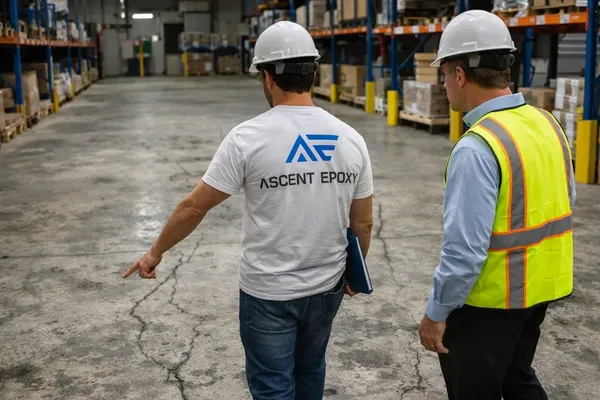
Facility Assessment
~Half dayWe walk the room, note what gets stored and spilled, map where the forklifts and foot traffic actually go, and take slab moisture readings in several zones — because a dock-edge slab and a cooler-floor slab almost never read the same near Biscayne Bay. Schedule yours free.
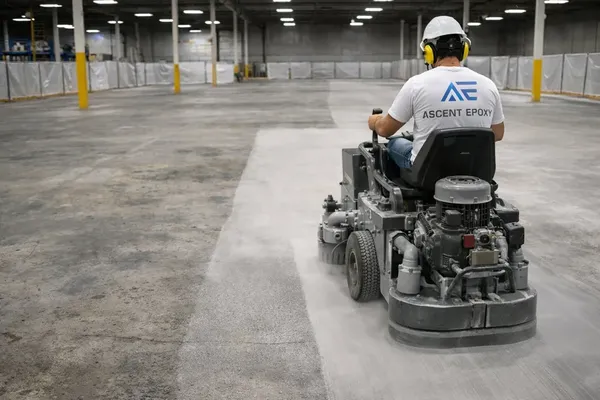
Industrial Slab Preparation
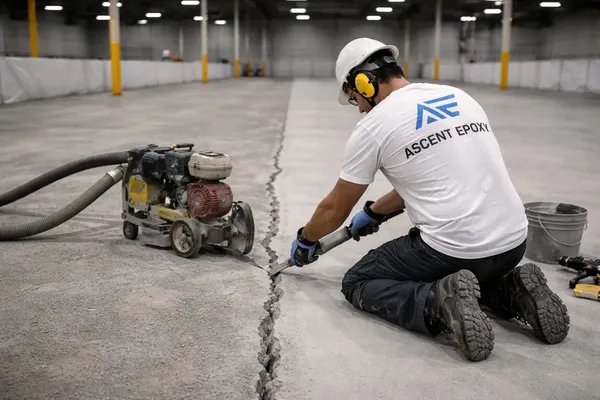
4–8 hrsDiamond grinding and shot blasting open up the porous limestone slab to a clean anchor profile and strip the laitance and old sealers that salt air leaves behind. On big tilt-up floors we budget the extra prep hours so no corner gets shortcut, then fill cracks, control joints, and spalled dock edges before any coating.
Primer & Moisture Barrier
2–4 hrsIndustrial-grade primer locks into the profiled slab and bonds the epoxy build to the concrete. Wherever Step 1's readings ran high — and with Miami's water table they often do — we first roll a vapor-mitigation barrier so rising moisture can't blister the finish off months later.
Epoxy System Application
1–3 daysThe build coats go down in the chemistry the room called for — chemical-resistant, impact-rated, urethane-cement, or ESD-controlled. Forklift lanes, cross-dock zones, color coding, and non-slip aggregate at wet and wash-down areas are broadcast in as we go, not painted on afterward.
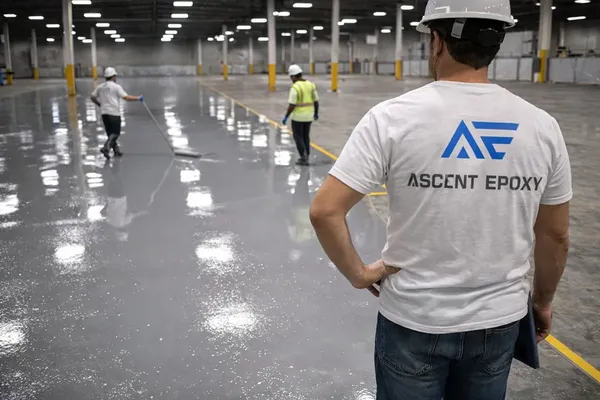
Curing & Handoff
3–7 daysThe system cures under monitored temperature and humidity — we hold the schedule to the conditions, not the calendar — then we check hardness, adhesion, and chemical resistance before we hand the floor back. You get maintenance guidelines written for your specific system and room, plus a written 25-year warranty against delamination, peeling, cracking, and adhesion failure — on paper before any deposit.
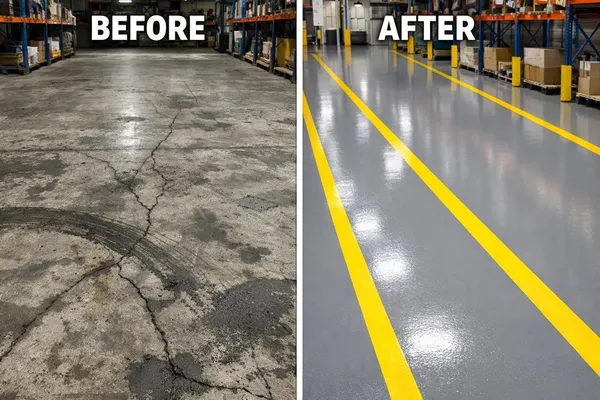
Ready to Start? Step 1 Is Free.
Schedule your no-obligation consultation and see finish samples in your space.
Industrial Floors We've Laid Around Miami-Dade
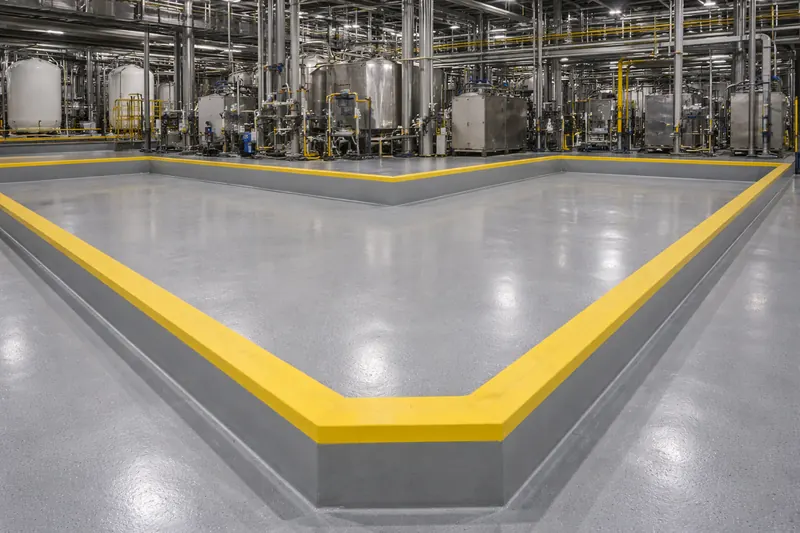
Warehouse, cold-storage, and processing-room installs from the Doral trade corridor to Hialeah and Medley.
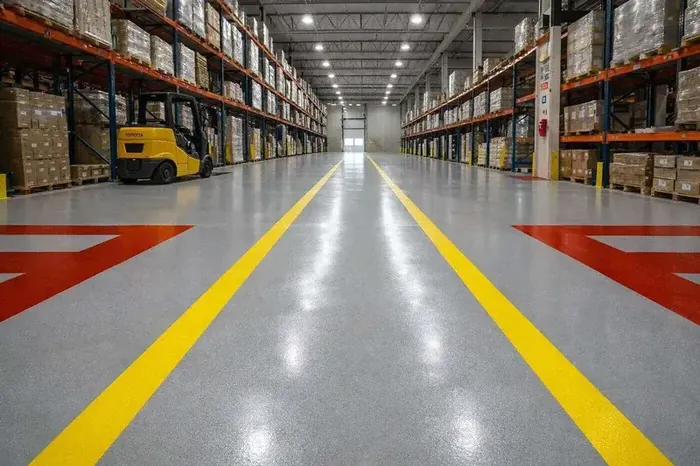
Three Systems for Miami's Three Hardest Rooms
The washdown kitchen, the freight floor, and the chemical-storage bay each fail a different way. Here's the coating each one actually needs.
Urethane Cement Flooring
This is the floor for the rooms that feed Miami's restaurants and hotels. A commissary, a central bakery, a seafood-processing house, or a brewery floor gets hosed, sanitized, and hit with hot-and-cold cycling every shift — conditions that lift ordinary epoxy off the slab. Urethane cement fuses to the concrete and ignores the thermal shock of steam cleaning and walk-in-freezer thresholds that would crack a conventional coating.
It also stands up to the food acids, caustic cleaners, and animal fats that pool on a working kitchen or processing floor, while staying USDA/FDA-friendly for back-of-house inspection. And because it returns to service in about 24 hours, a kitchen behind a busy South Beach or Brickell operation can be back on the line the next day instead of dark for a week — the kind of turnaround a hospitality calendar can't give up.
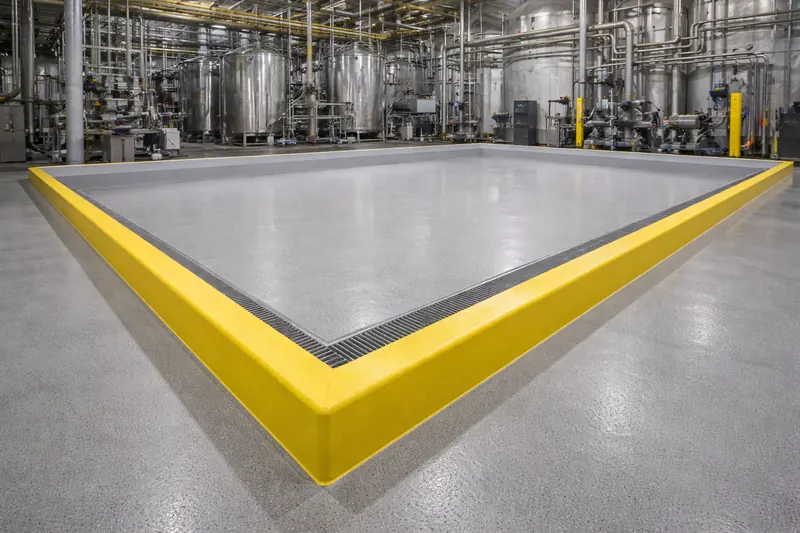
Warehouse Floor Coatings
A Miami import or re-export warehouse never really stops — freight off the port and the airport cargo apron cycles in and out around the clock, with reach trucks pivoting on the same turns and racking driving tons onto a few square inches. Leave that slab bare and the salt-laden air plus a near-surface water table will have it dusting and pitting before the lease is up.
Our warehouse build pairs a high-solids epoxy body with an abrasion-resistant topcoat tuned for forklift wear, and we broadcast the aisle striping, staging grids, pedestrian paths, and dock-edge color coding right into the system. Because most of these floors can't go dark, we coat them in zones on a night or weekend schedule so the Doral, Hialeah, and Medley operations keep shipping while one bay cures.
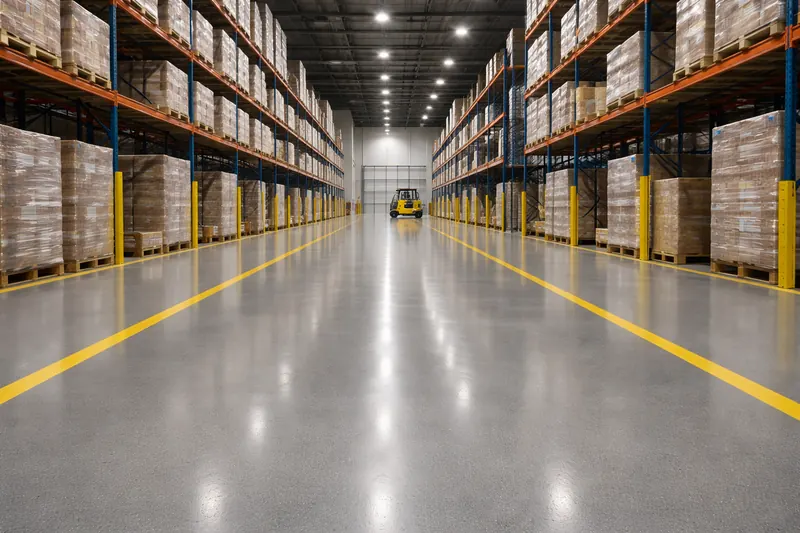
Secondary Containment Areas
Anything that holds drummed chemicals, fuels, or solvents around Miami-Dade — a customs-bonded importer's hazmat store, a fuel depot near the port, a plating or pool-chemical operation — owes a compliant containment floor. It isn't a nice-to-have: EPA, OSHA, and Florida's DEP all require it, and a spill that reaches the ground here has a short trip to the aquifer and to Biscayne Bay.
We build chemical-resistant containment floors with integrated curbing and berms sized to retain 110% of the largest vessel's volume, the federal and state threshold, and we detail the coves and penetrations so nothing escapes through a seam. On Miami's flat, high-water-table sites that perimeter is the whole point — and the coating itself shrugs off the acids, bases, fuels, and organic solvents stored inside it.
Rated 5.0★ — What Miami Owners Say
Our 16 verified Google reviews span garages, homes, and commercial slabs across Miami-Dade. Here's a cross-section — read every one on Google.
"Really professional crew. They put plastic over my wife's car, wore shoe covers when they came inside to use the bathroom, cleaned up everything. Little things like that matter to me."
"I had Ascent Epoxy redo my garage floor last month. From start to finish they were professional, punctual, and the result is stunning — durable, smooth, and easy to clean. Worth every penny."
"Amazing service. Love my Epoxy Floor."
Industrial Epoxy Flooring FAQs — Miami
Common questions about industrial epoxy flooring for Miami facilities.
We install industrial epoxy flooring across Miami-Dade's Doral, Medley, and Hialeah logistics corridors — pharma and food-distribution warehouses, auto-parts and 3PL facilities, manufacturing plants, and PortMiami-fed cargo operations, including:
- Warehouses and distribution centers
- Manufacturing plants
- Chemical processing facilities
- Food and beverage processing plants
- Maintenance bays and service shops
- Control rooms and clean environments
Our systems are engineered to handle the specific demands of each facility type, from chemical resistance in processing plants to impact resistance in high-traffic warehouses.
South Florida's regional humidity averaging around 75%, plus a high water table under most Miami-Dade slabs, is critical for large industrial floors. Moisture vapor driving up through the slab and getting trapped beneath the coating causes delamination and peeling, and on expansive warehouse floors even small moisture variations can affect thousands of square feet.
We perform comprehensive moisture testing across the entire slab using calcium chloride and relative humidity probe methods. When readings are elevated, we apply moisture-mitigating primers and vapor barrier coatings before the epoxy system goes down. We also schedule installation windows around optimal humidity conditions to ensure a lasting bond.
Yes. Our industrial epoxy systems are formulated with chemical-resistant resins that withstand exposure to acids, alkalis, solvents, petroleum products, oils, and fuels.
We offer various chemical resistance ratings depending on the specific chemicals present in your facility. Standard epoxy handles oil, grease, and mild chemicals. For facilities that deal with concentrated acids and harsh solvents, we install novolac epoxy systems with the highest chemical resistance ratings available.
Yes. We install OSHA-compliant safety line marking as part of our industrial epoxy flooring systems. This includes:
- Pedestrian walkways
- Forklift traffic lanes
- Hazard zones and restricted areas
- Equipment placement boundaries
- Emergency exit paths
- Color-coded area designations
All markings are applied with durable epoxy paint that bonds directly to the floor system and withstands heavy daily traffic without fading or peeling.
Industrial epoxy installation typically takes 3 to 7 days depending on the facility size, condition of the existing concrete slab, and complexity of the coating system required.
For larger facilities, we offer phased installation that allows you to keep portions of your operation running while we work on other sections. This minimizes downtime and keeps your production schedule on track. We provide a detailed project timeline during the estimate phase so you can plan around the installation.